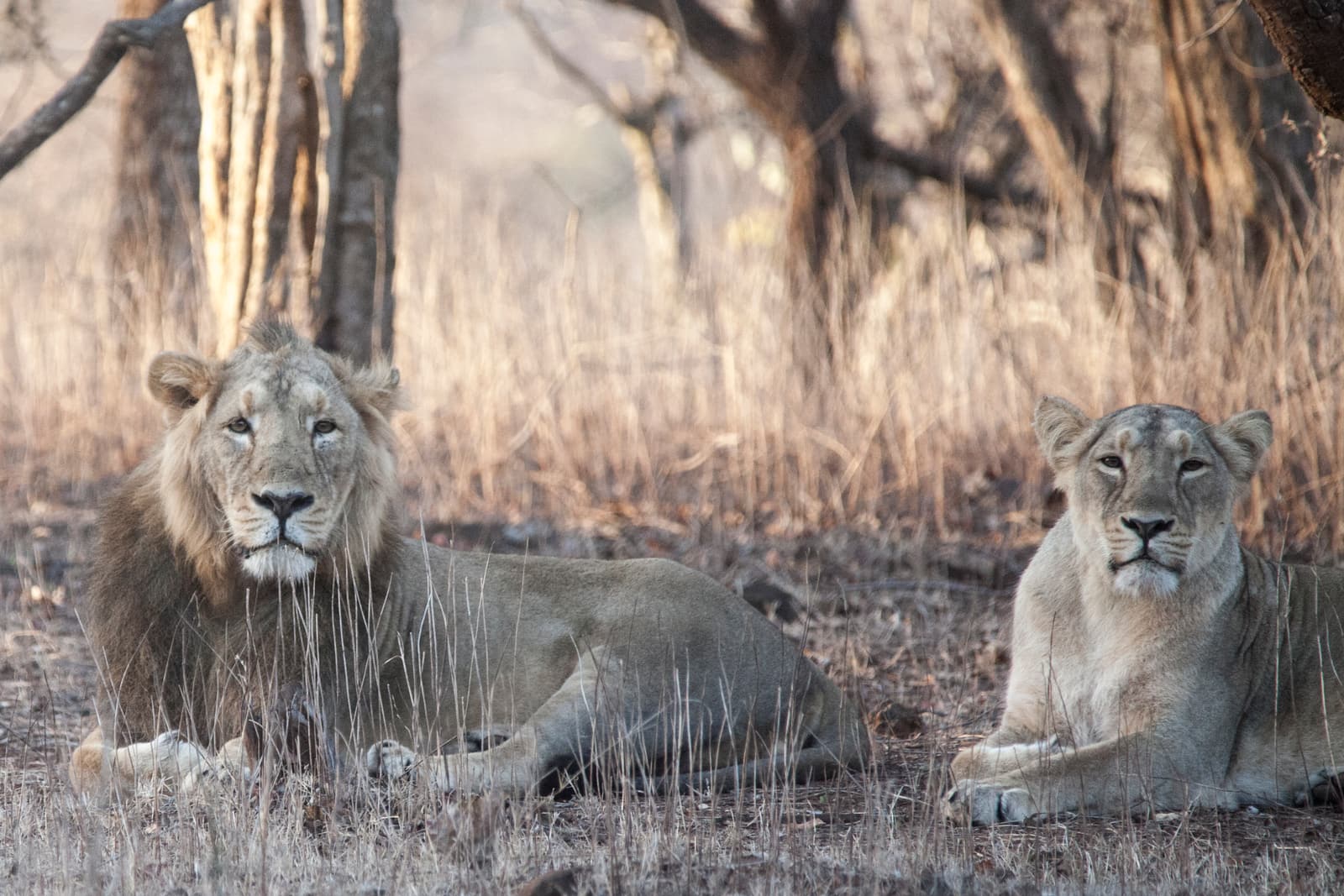
Gir National Park and Wildlife Sanctuary covers a little over 1,400 square kilometres of dry deciduous forest, thorn scrub and grassland in the hills of southern Saurashtra, of which roughly 258 square kilometres at the core is national park. It is the last stronghold of the Asiatic lion, Panthera leo persica — and, increasingly, the heart of a much larger lion landscape that spills out across farmland and coast.
Gir at a glance
- Where: Junagadh, Gir Somnath and Amreli districts, Gujarat. Safaris start from Sasan Gir.
- Season: usually 16 October to 15 June. Closed for the monsoon.
- Safaris: the Gir Jungle Trail (open gypsy, about three hours, three slots a day) and Devalia Safari Park (bus or gypsy, under an hour).
- Permits: online only, from the Gujarat Forest Department.
- Lions: 891 in the Forest Department’s 2025 population estimate, up from 674 in 2020, spread across Gir and the surrounding districts.
How the Gir Jungle Trail safari works
The Jungle Trail is a drive through the tourism zone of the sanctuary in an open, registered gypsy with a driver and a Forest Department guide. One permit covers one vehicle with up to six visitors; a small child may be allowed in addition under current rules. There are normally three slots a day — one from around sunrise, one in the late morning and one in the afternoon — each lasting about three hours, with timings adjusted between winter and summer.
You do not choose where you go. The forest is divided into a number of numbered routes, and your vehicle is allotted one at the reception centre at Sinh Sadan in Sasan. Some routes pass Kamleshwar Dam; all pass through good lion habitat. Trackers employed by the Forest Department keep a general watch on the lions’ movements, which is one reason sightings are frequent — but they are never guaranteed.
Booking the permit, step by step
- Go to girlion.gujarat.gov.in — and nowhere else — and choose “Gir Jungle Trail” or “Devalia Safari Park”.
- Pick the date and slot. Bookings open a set period in advance and popular dates sell out quickly.
- Enter the name, age and photo-ID details of every visitor exactly as on the document they will carry. Foreign nationals use their passport.
- Pay online and save the e-permit.
- On the day, report to Sinh Sadan in good time with the permit and the original IDs. Gypsy and guide are assigned there and paid for separately.
What it costs
There are three separate charges: the permit fee per vehicle (higher for foreign nationals than for Indians, and higher on weekends and public holidays), the gypsy hire, and the guide fee. A camera fee may also apply to some equipment. The Forest Department revises these from time to time, so we deliberately do not print figures that could be out of date — check the portal for current rates before you budget. As a rough guide, Indian visitors sharing a full gypsy find the Jungle Trail inexpensive per head; for foreign visitors the permit is several times dearer.
Jungle Trail or Devalia?
| Gir Jungle Trail | Devalia Safari Park | |
|---|---|---|
| What it is | A drive through open, wild forest | A fenced interpretation zone of natural habitat |
| Duration | About 3 hours | Under 1 hour |
| Vehicle | Open gypsy, up to 6 visitors | Forest Department bus, or gypsy |
| Lion sighting | Frequent, never guaranteed | Very likely |
| Other wildlife | Leopard (rare), deer, antelope, crocodile, 300+ birds | Leopard in enclosure, deer, antelope |
| Closed | About 16 June–15 October | Normally Wednesdays; check monsoon arrangements |
| Best for | The real wilderness experience | Families, short stays, a sure sighting |
 Gir National Park & Sanctuary
Gir Jungle Trail
The open-jeep safari through wild lion country
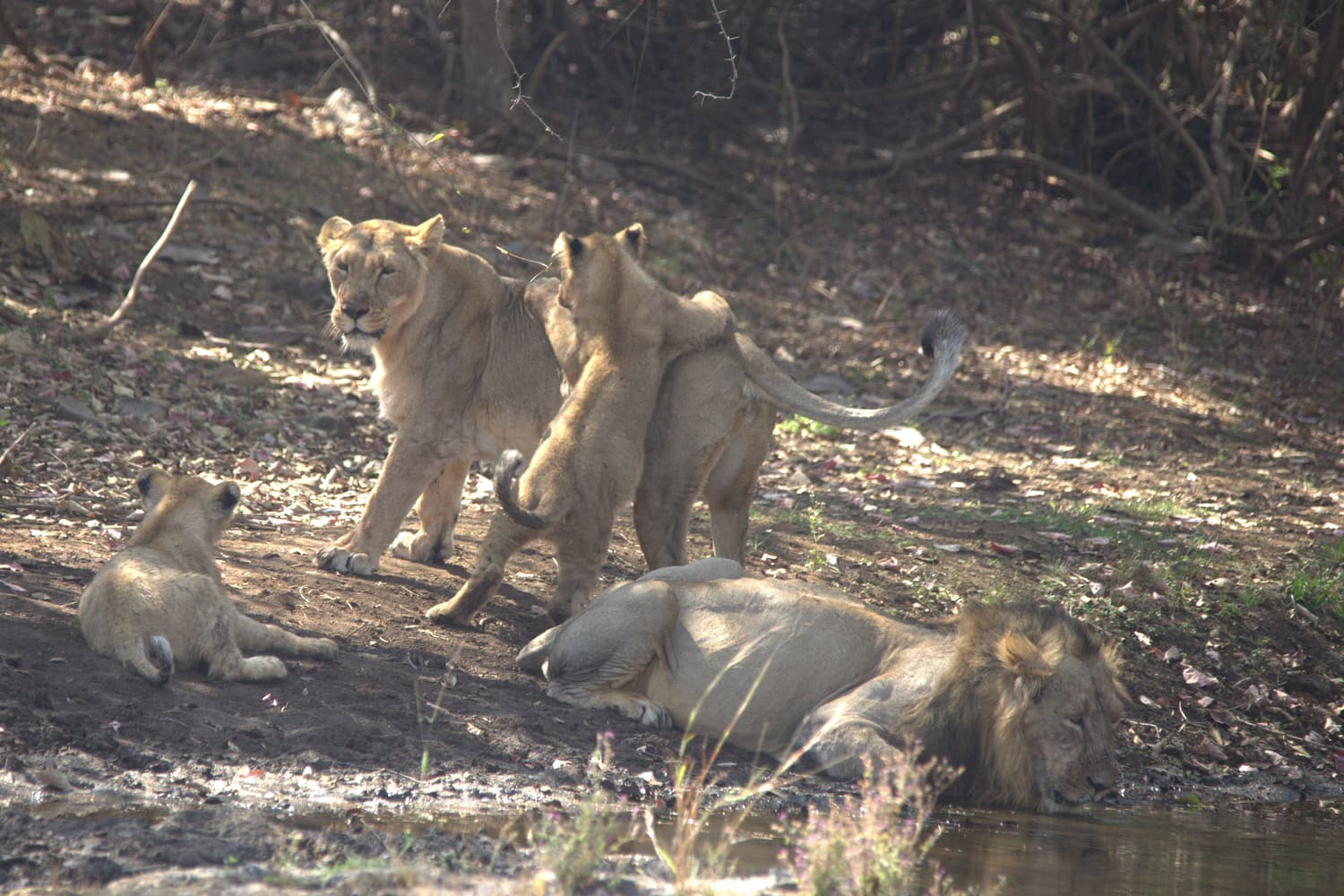
The main event: a roughly three-hour drive in an open gypsy along a forest route allotted at Sasan, with a Forest Department guide, through the tourism zone of the sanctuary where Asiatic lions, leopards, deer and hundreds of bird species live wild. Entry is by official e-permit only.
 Gir National Park & Sanctuary
Devalia Safari Park
The Gir Interpretation Zone — a short, near-certain lion sighting
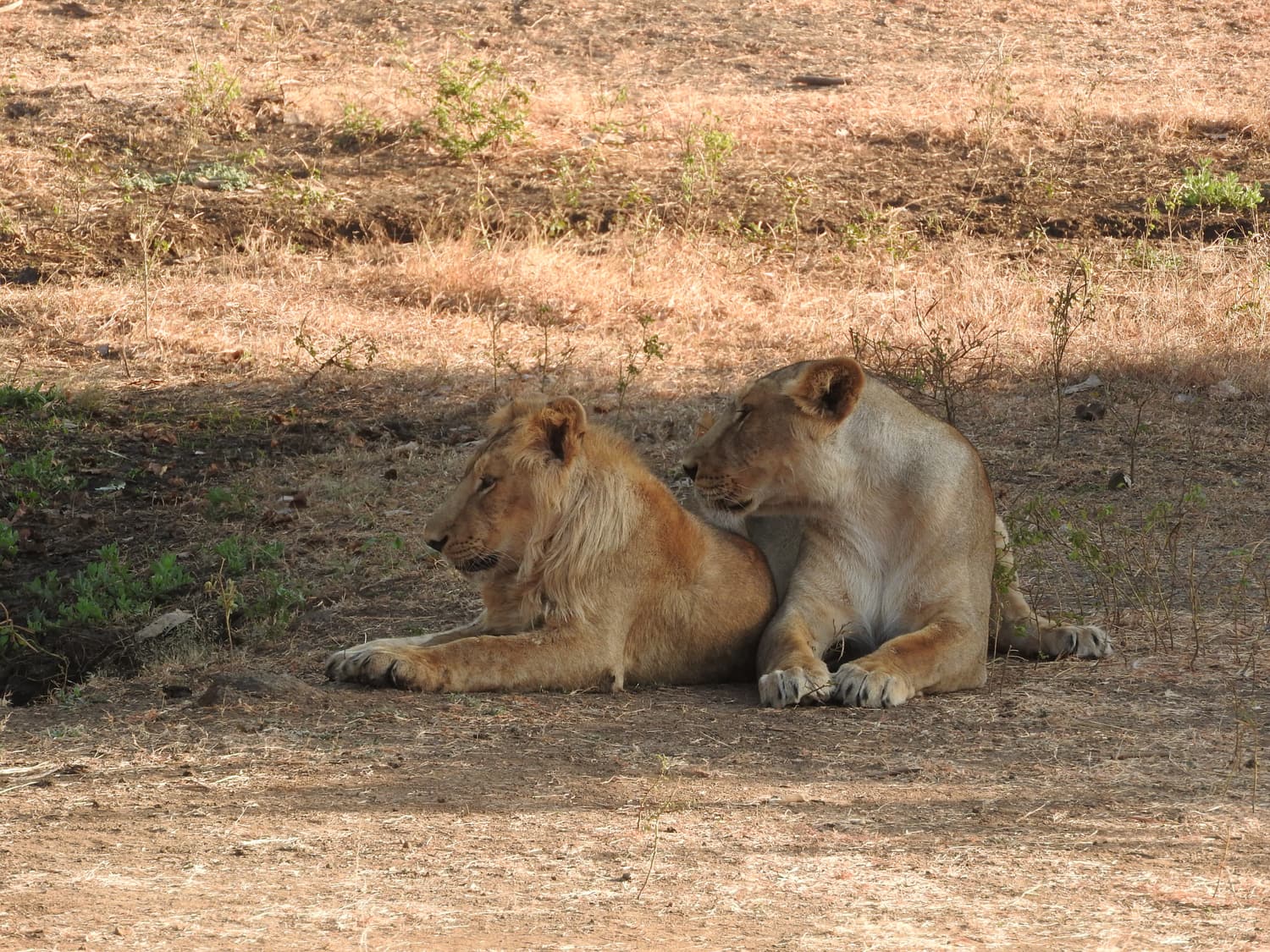
A large fenced tract of typical Gir habitat about 12 km west of Sasan, where lions, leopards and herbivores can be seen on a short bus or gypsy round. It is the fallback when Jungle Trail permits are sold out, and a good choice with small children.
 Gir National Park & Sanctuary
Sasan Gir
The village where every safari begins
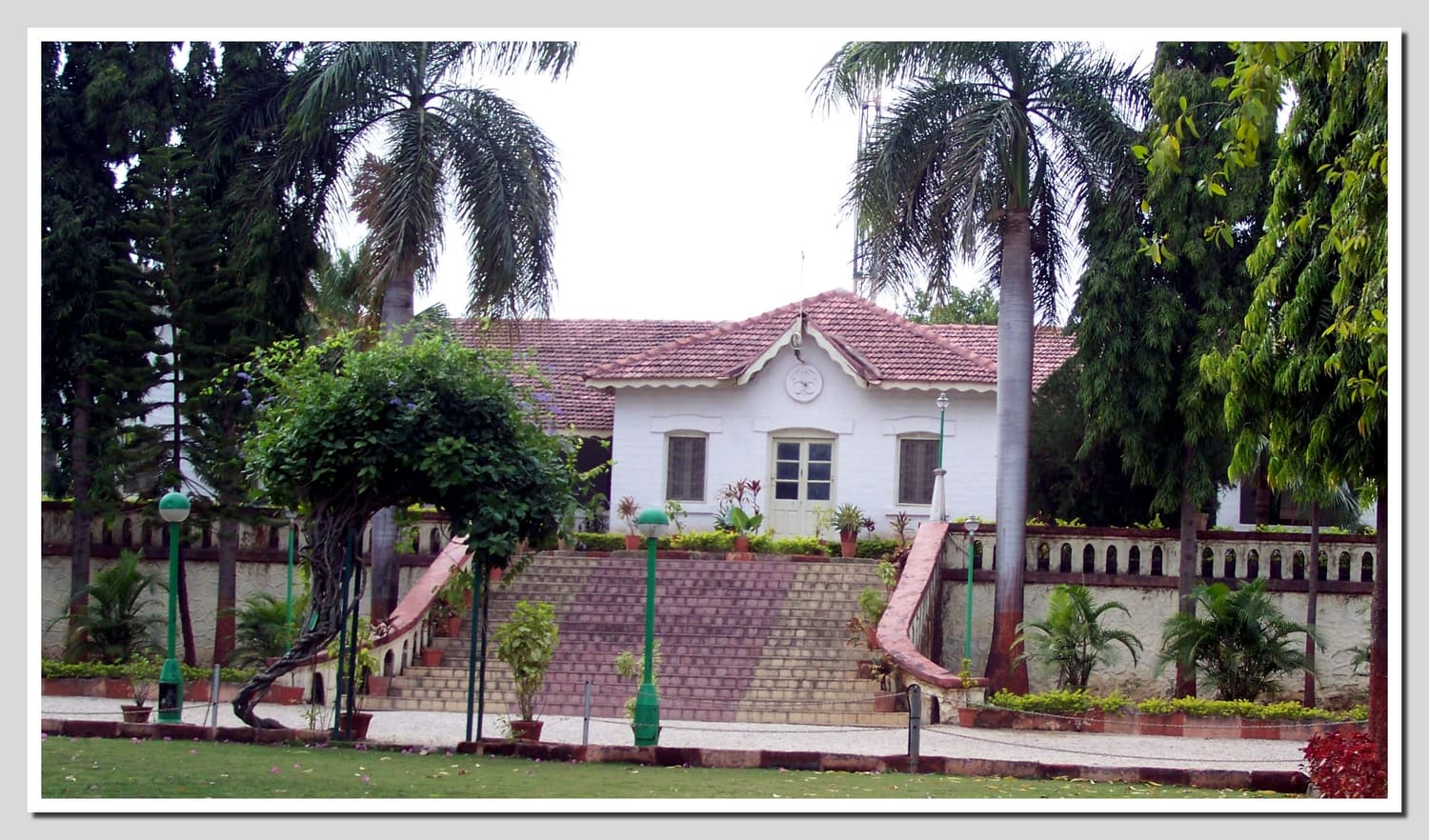
A small village on the Hiran river that serves as park headquarters. Sinh Sadan, the Forest Department campus, is where permits are checked and jeeps and guides assigned; around it are lodges, resorts, a tiny railway station and mango orchards.
 Somnath, Diu & the Saurashtra coast
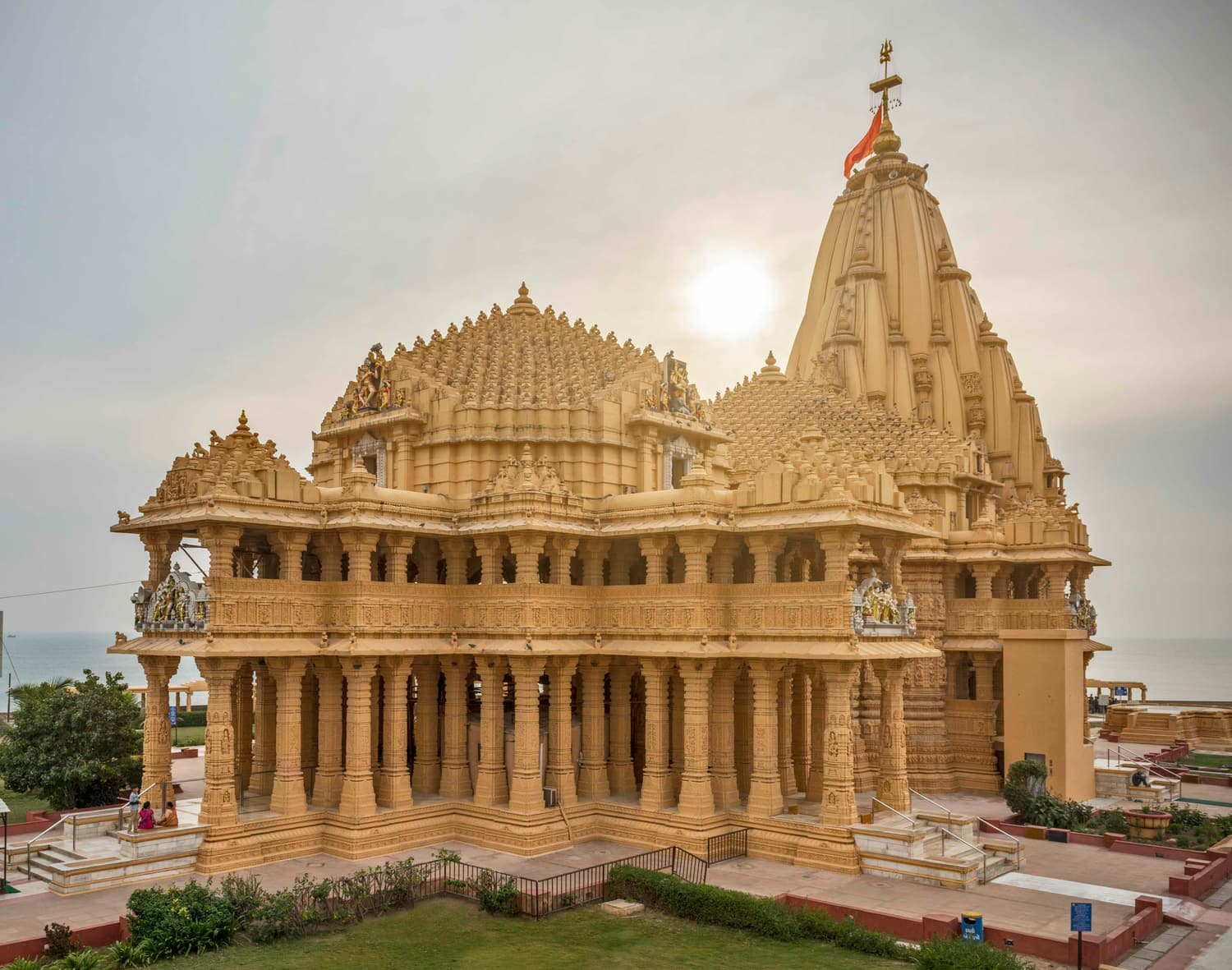
Somnath Temple
The first jyotirlinga, on the edge of the Arabian Sea
One of the most sacred Shiva temples in India, counted first among the twelve jyotirlingas and rebuilt after Independence on a site destroyed and restored many times. About an hour from Sasan, it is the natural partner to a Gir safari.
Our advice is to do both: Devalia on the afternoon you arrive, and two Jungle Trail drives over the next day or two. There is also a second safari park, Ambardi, near Dhari on the eastern side.
The lions
Asiatic lions are a little smaller than their African cousins. Males have a shorter, sparser mane that leaves the ears visible, and both sexes usually show a long fold of skin along the belly. Prides are smaller too, and males and females often keep apart except when mating or on a large kill. They feed mainly on chital, sambar, nilgai and wild boar — and on livestock, which is central to their uneasy but remarkably tolerant relationship with the people who live alongside them.
In the heat of the day lions do what all cats do and sleep, typically in the shade beside a track or a dry stream bed. The first and last hours of daylight are when they move, call and drink.
Other wildlife
- Leopards are numerous in Gir but seldom seen; dusk, and rocky or riverside country, give the best chance.
- Deer and antelope: chital in large herds, sambar, nilgai, the small four-horned antelope (chousingha) and chinkara in the open scrub.
- Marsh crocodiles at Kamleshwar Dam and along the rivers; Gir has bred and released them for decades.
- Smaller hunters: striped hyena, golden jackal, jungle cat, the tiny rusty-spotted cat, mongooses and honey badger — mostly nocturnal.
- Birds: more than 300 species, among them crested serpent eagle, changeable hawk-eagle, Indian pitta in the rains, paradise flycatcher, painted stork, owls, vultures and countless peafowl.
The forest
Gir is the largest tract of dry deciduous forest left in western India. Teak dominates the western half; elsewhere it gives way to acacia and ber scrub, flame-of-the-forest that blazes orange in early spring, and ribbons of evergreen jamun, karanj and banyan along the rivers. Seven rivers rise in or cross these hills, among them the Hiran, Shetrunji, Machhundri and Shingoda, and the reservoirs on them are the forest’s dry-season lifeline.
People of Gir
The Maldharis
The Maldharis are pastoralists — the name means “keepers of stock” — who have lived in the Gir forest for generations in thorn-fenced settlements called nesses, grazing buffalo and cattle and selling milk and ghee. They lose animals to lions and accept it with a patience that has become famous. Many families were resettled outside the national park from the 1970s onwards; others remain in the sanctuary. If your route passes a ness, remember it is somebody’s home.
The Siddis
Around Gir, notably in the village of Jambur near Talala, live the Siddis: Gujaratis of East African descent whose ancestors arrived centuries ago as sailors, soldiers and servants of the region’s rulers. They are devotees of the saint Bava Gor, and their Dhamal — a fast, percussive dance performed in peacock feathers and painted faces — is the cultural performance most visitors to Sasan see. If you attend one, choose a show from which the troupe is paid fairly.
How the lions were saved
By the late nineteenth century hunting had wiped the Asiatic lion from almost all of its range. The survivors were confined to Gir, the private hunting ground of the Nawabs of Junagadh; estimates of their number around 1900 vary widely and were probably too low, but it was certainly a remnant. With encouragement from the Viceroy, Lord Curzon — who is said to have cancelled his own lion shoot — the Nawabs restricted and then all but ended the hunting.
After Independence Gir was declared a wildlife sanctuary in 1965 and its core a national park in 1975. Protection, the resettlement of some villages and decades of work by the Forest Department and local people did the rest. The population has grown at every recent count, and lions now live far beyond the old boundaries — on farmland, in coastal scrub and around towns. That success brings new problems: open wells, roads and railway lines that kill lions, and the risk that a single disease outbreak could strike a population concentrated in one region.
Sample itineraries
Two nights: the essentials
- Day 1: arrive Sasan by early afternoon; Devalia Safari Park; orientation centre.
- Day 2: morning Jungle Trail; afternoon and evening at Somnath for aarti and the seafront.
- Day 3: second morning Jungle Trail; depart.
Five days: lions, temples and the sea
- Day 1: arrive Junagadh; Mahabat Maqbara and Uparkot.
- Day 2: Girnar by ropeway or the steps at dawn; drive to Sasan.
- Day 3: morning and afternoon Jungle Trail drives.
- Day 4: Devalia early; Somnath; continue to Diu.
- Day 5: Diu’s fort, churches and beaches.
What to wear and bring
- Colours: khaki, olive, brown or grey. Avoid white, red and anything bright.
- Winter (November–February): mornings in an open jeep are genuinely cold — a fleece or jacket, a cap and even gloves. It warms up quickly by mid-morning, so dress in layers.
- Summer (March–June): light long-sleeved cotton, a wide-brimmed hat, sunglasses, sunscreen and plenty of water.
- Always: closed shoes, a scarf or buff for dust, binoculars, your permit and original photo ID.
- Leave behind: perfume, plastic bags, food to eat in the forest, and drones — which are not permitted.
Photography, with manners
- A lens of 200–400 mm suits most situations; lions are often close, birds are not.
- Never ask the driver to leave the track, cut off an animal’s path or edge closer than the guide advises.
- No flash, no calling or whistling to make an animal look up, and no playback of bird calls.
- Stay seated inside the vehicle. Getting down is forbidden except where the guide says otherwise.
- Do not offer money for an “off-route” lion show. Illegal staged sightings harm the animals and are prosecuted.
- Ask before photographing Maldhari or Siddi people, and accept a refusal gracefully.
- Think before posting exact locations of lions outside the park on social media.
Money, connectivity and safety
- Carry cash for guides, tips and small shops; cards and digital payments work at larger hotels.
- Gujarat is a dry state: alcohol is not sold at Sasan. Diu, being a union territory, is the exception.
- Food is overwhelmingly vegetarian and often excellent — try a Kathiyawadi thali.
- Mobile coverage is fair in Sasan village and weak inside the forest.
- Never walk on forest roads at dusk or after dark, and keep children close at lodges on the park boundary.
Ready to choose dates? See when to visit, how to get here and where to stay.
Combine your trip
Gujarat’s other great journey lies far to the north, in Kutch. Our Dholavira guide covers the Harappan city on Khadir Bet island in the Great Rann, a UNESCO World Heritage Site. It is roughly 400–450 km from Sasan by road, usually via Rajkot, so give Kutch at least two nights of its own rather than treating it as a side trip.
Heading on into Rajasthan? Ajmer Junction, the railhead for Pushkar, is on the main line from Ahmedabad towards Delhi, so the lake town fits easily into a longer Gujarat and Rajasthan journey. Our Pushkar travel guide covers the ghats, the Brahma Temple and the November camel fair.